
Roger Mills County Arrest Records and Court Charges
An arrest record is the account of an arrest itself. It notes who was taken into custody, the agency that made the arrest, the booking time, and the suspected offenses listed at intake. In Roger Mills County, that side of the story sits with the Sheriff's Office and the county jail. A booking screen may list offenses an officer believed applied at the time, but those entries are preliminary. They are not the charges a court will rule on.
The court charge record is the next step. After an arrest, District Attorney Angela Marsee and the District 2 prosecutors review the case and decide which crimes to file. Those formal charges go to the Court Clerk and become part of the criminal case. The charges after arrest carry a count number, an offense name, a statute citation, a severity level, and a filing date. For booking detail and the jail roster, see the Roger Mills County inmate records page. The full case file, with pleas and sentencing, lives in the criminal court record.
How to Find Roger Mills County Arrest Records and Charges
Filed charges in Roger Mills County are searched through Oklahoma's statewide court systems rather than a county-built portal. The Oklahoma State Courts Network (OSCN) and On Demand Court Records (ODCR) both index Roger Mills County District Court cases. Charges and charge status appear inside the case docket. Arrest and booking detail, by contrast, comes from the sheriff and the jail intake side, not from these court dockets.
- Open the OSCN docket search or the ODCR public search and choose Roger Mills among the Oklahoma district courts.
- Search by the defendant's name in Last, First format, or enter the case number if you already know it.
- Open the matching case and read the charge list, where each count shows the offense name and the statute cited.
- Check each charge's code, severity level, and current status, since charges can change after they are first filed.
Oklahoma case numbers use type prefixes that signal the charge level. A felony case usually carries the CF prefix, a misdemeanor uses CM, and a probable cause filing may use PC. Knowing the prefix helps you confirm you are reading the right record before you study the charges.
How Charges Get Filed After an Arrest: Complaint, Information, and Indictment
The path from arrest to charge follows a clear order. A person is arrested and booked first. The charge record then opens when the prosecutor files a charging document with the Court Clerk. That document names the crimes, lists each count, and cites the statute the state says was broken. Oklahoma uses three main charging documents, and the type often signals how serious the case is.
| Complaint | Information | Indictment | |
|---|---|---|---|
| Filed By | Officer / Prosecutor | Prosecutor | Grand Jury |
| Common For | Misdemeanors | Many felonies | Serious felonies |
| Starts | The case | The case | The case |
Roger Mills County falls in Oklahoma Prosecutorial District 2, which also covers Beckham, Custer, Ellis, and Washita Counties. The District Attorney District 2 office lists its Roger Mills contact at the county courthouse, P.O. Box 276, Cheyenne, OK 73628, reached at (580) 303-6055.
The District Attorneys Council page for District 2 shows the prosecutor contact and payment details that connect an arrest to the charges that follow. You can view it here: Oklahoma District Attorney District 2.
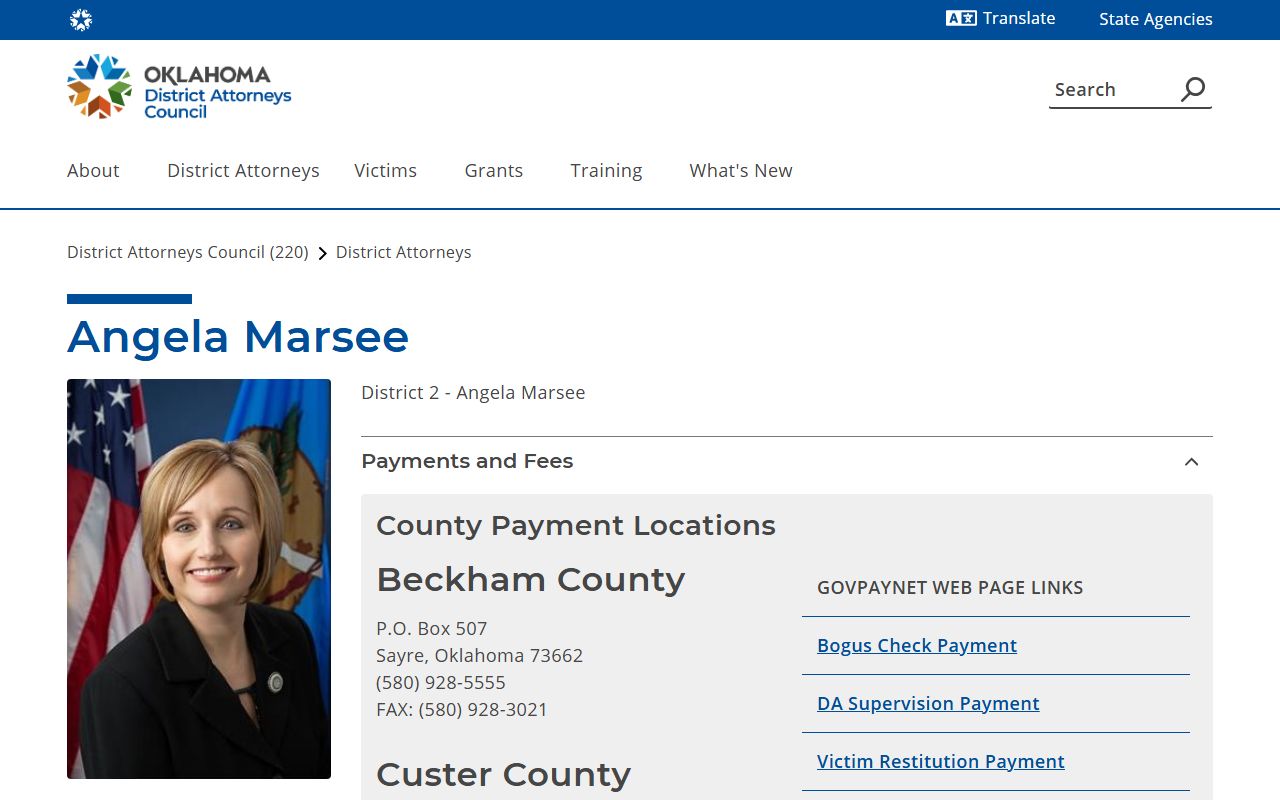
The office that handles those charges is the same one a reader contacts about restitution, diversion, or prosecution payments tied to a Roger Mills County case. Most charges in the county begin with an Information filed by the district attorney rather than a grand jury indictment.
Charge Status and What It Means
Charges rarely stay frozen. As a case moves, a charge can be amended, reduced to a lesser offense, added, dropped, or dismissed. The docket shows these shifts, so the status you read today may differ from the offense first listed at booking. Reading the current status matters more than reading the first entry.
| Status | What It Means |
|---|---|
| Pending | The charge has been filed and the case is still open, with no final result yet. |
| Amended / Reduced | The prosecutor changed the charge, often to a lesser offense or a different statute. |
| Dismissed | The charge was dropped by the court, with or without the chance to refile. |
| Nolle Prosequi | The prosecutor formally chose not to pursue the charge any further. |
A dropped or dismissed charge does not always vanish from public view. The docket entry can remain visible even after the charge ends. Sealing or expunging the record is a separate step that takes a court order, which the restricted-records section below explains.
Note: A charge listed on a jail booking screen is not the final court charge, so always confirm the filed charge and its status in OSCN or ODCR.
Charges vs. Convictions
Being charged is an accusation, not a finding of guilt. A charge means the state believes there is enough cause to bring the case. A conviction comes only after a plea or a verdict. Roger Mills County arrest records and charge entries can sit on the docket for months before any conviction exists, and many charges never become convictions at all.
| Charge | Conviction | |
|---|---|---|
| Stage | Accusation | Verdict or plea |
| Burden of Proof | Probable cause | Beyond reasonable doubt |
| Public Record | Yes | Yes |
The full record of how a charge ended, including any plea, finding, or sentence, sits in the Roger Mills County criminal court records. That file shows the disposition, while the charge record here shows what was filed and how it changed along the way.
Sealed vs. Expunged Records
People often treat sealing and expungement as the same thing, but they differ. A sealed record is hidden from ordinary public view, while an expunged record is treated as if it never existed. Oklahoma handles both through the District Court, so a Roger Mills request is filed in the district court tied to the arrest or case.
| Sealed | Expunged | |
|---|---|---|
| Visibility | Hidden from public | Destroyed / treated as never existed |
| Law Enforcement | Limited access | Very limited |
| Eligibility | Set by 22 O.S. 18 and 22 O.S. 19, based on charge type and disposition | Granted by court order once statutory conditions are met |
Eligibility depends on the charge type, the disposition, the time since the case closed, prior convictions, and any pending charges. A dismissal or a deferred sentence does not erase a record on its own. The person usually must file a petition and obtain a separate sealing order, which is then sent to each agency that holds the record.
Charge Codes and Severity Levels
Each charge is tied to a specific Oklahoma statute, and that citation is the charge code. The code tells you the exact offense and its severity. A single arrest can produce several separate charges, each with its own count number, statute, and level. The severity level is what divides the case types you see on the docket.
- Felony charges, the most serious, commonly carry the CF case prefix.
- Misdemeanor charges, less serious offenses, commonly carry the CM prefix.
- Probable cause filings may appear under a PC prefix while a case is early.
- Traffic matters filed in district court use the TR prefix and can include criminal traffic counts.
When you read a Roger Mills County charge, match the statute citation to the count to understand what the state actually alleged. Two charges with similar names can sit at very different severity levels depending on the exact statute cited.
Statewide Charge and Criminal History Lookups
Charges filed in Roger Mills County feed into a person's broader Oklahoma criminal history, but county dockets are only one piece. For sentenced offenders in state custody, the Oklahoma Department of Corrections offender lookup is the statewide tool. Its own terms note the data is abbreviated and is not a complete explanation of the offense or sentence, so it should be read as a pointer rather than a full record.
For records that the courts do not post online, Oklahoma's open records process is the fallback. The Attorney General open records request page explains how to ask a public body for records and lists copy fee examples. Booking and arrest information held by the sheriff is requested on the law enforcement side, separate from the court charge file.
Background Check Considerations
A casual name search on a court docket is not the same as a regulated background check. Employers, landlords, and lenders that screen people must follow the federal Fair Credit Reporting Act, which sets rules for accuracy, consent, and dispute. Reading Roger Mills County arrest records out of curiosity does not carry those duties, but using them to make a hiring or housing decision does.
Important: This site is not a consumer reporting agency under the FCRA, and its information cannot be used for employment, tenant, credit, or insurance screening.
Restricted Charge Records in Roger Mills County
Not every charge is open to the public. Oklahoma's Open Records Act, at 51 O.S. 24A.5, makes most government records open during business hours, yet 51 O.S. 24A.8 lets law enforcement withhold investigative and security-sensitive material. Several charge-related categories are held back from ordinary docket results.
- Juvenile charges, which carry strong confidentiality and are not treated like adult cases.
- Sealed or expunged charges, which should no longer surface in normal public searches.
- Charges tied to ongoing investigations, where the full report can stay closed.
- Personal identifiers such as Social Security numbers, full dates of birth, and minor names, which are redacted.
When a charge is sealed or restricted, the Roger Mills County Court Clerk is the office to ask about access rules and certified copies. The clerk, not the sheriff or the district attorney, is the main custodian of filed court case records.